
How Travel Agencies Can Streamline Corporate Travel Bookings
Corporate travel is more than booking a flight and sending a ticket.
A corporate travel request can involve flights, hotels, visa documentation, approvals, commercial terms, invoices, payment follow-ups, amendments and last-minute changes. When these activities are managed through scattered emails, WhatsApp messages, spreadsheets and individual memory, even a small booking can become operationally complicated.
For travel agencies, the objective should not simply be to process more bookings.
It should be to build a system where every booking moves through a clear, consistent and trackable process.
Here's how travel agencies can streamline their corporate travel operations.
1. Start With One Standard Corporate Travel Workflow
Every corporate booking should follow a defined journey:
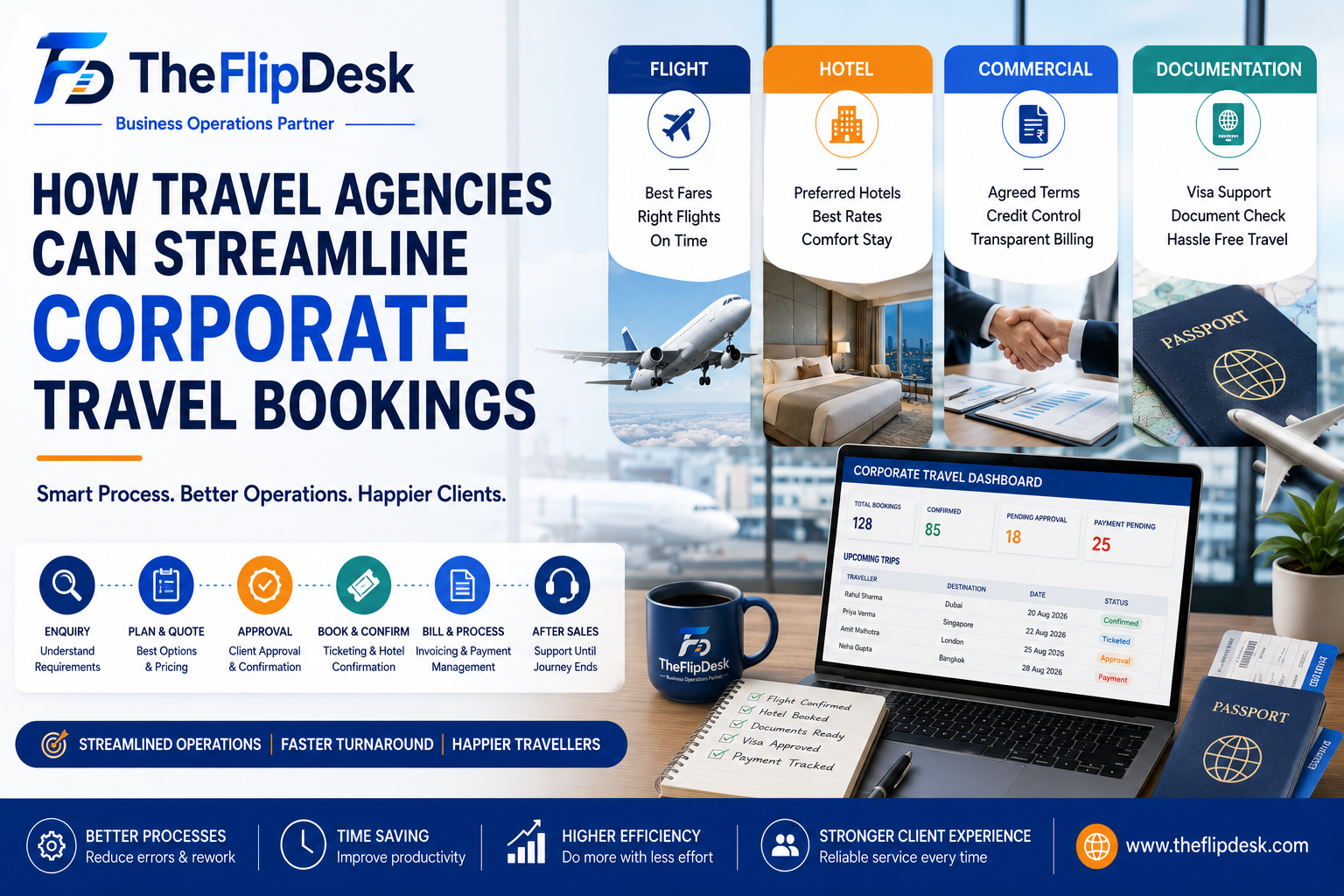
Enquiry → Requirement Capture → Options → Quotation → Approval → Confirmation → Documentation → Billing → Payment → After-Sales → Closure
The exact steps can vary by agency and client, but the principle remains the same: every booking should have a clear status and next action.
This becomes particularly important when multiple team members are handling the same account.
Instead of asking:
"What's happening with this booking?"
the team should be able to look at the booking record and immediately understand:
Current Status → Pending Action → Responsible Person → Next Follow-Up
That simple visibility can eliminate a significant amount of unnecessary internal communication.
2. Flight Booking Operations
Flight bookings are often the most time-sensitive part of corporate travel.
A good process begins before the fare is even searched.
Requirement
Capture the complete requirement:
Sector | Travel Date | Return Date | Traveller | Cabin | Preferred Timing | Airline Preference | Baggage | Flexibility
For international travel, passport and visa-related requirements may also need to be considered.
Availability & Fare Comparison
Don't compare fares based only on price.
Corporate travellers may also care about:
Timing | Duration | Connections | Baggage | Refundability | Change Conditions | Airline Preference
A slightly higher fare may sometimes be more suitable if it offers better flexibility or a significantly better schedule.
Quotation
The quotation should clearly communicate:
Airline → Flight → Departure → Arrival → Baggage → Fare → Taxes → Change/Cancellation Conditions → Validity
The client should be able to understand the option without going through multiple messages.
Approval & Recheck
Before ticketing:
Client Approval → Fare Recheck → Availability Confirmation → Final Passenger Details → Ticketing
This final recheck is important because airfares and availability can change between quotation and confirmation.
Ticketing & Record
After issuance, the ticket and relevant itinerary should be shared with the traveller/client and recorded in the agency's booking system or operational tracker.
The booking should then move from:
Awaiting Approval → Confirmed → Ticketed
rather than remaining dependent on someone's inbox.
3. Hotel Booking Operations
Hotel bookings need a similar structured approach, but the information required is different.
A corporate hotel request may involve:
Destination → Check-in → Check-out → Room Count → Room Category → Meal Plan → Preferred Property → Location → Budget → Cancellation Terms
For corporate accounts, there may also be negotiated or preferred hotel rates.
Hotel Selection
Don't compare hotels only on room price.
Consider:
Location | Corporate Rate | Room Type | Breakfast | Wi-Fi | Cancellation Policy | Check-in/Check-out | Payment Terms
For a business traveller, a hotel located closer to the meeting location can sometimes be more valuable than a cheaper hotel several kilometres away.
Rate & Condition Verification
Before confirming, verify:
- Room category
- Number of rooms
- Number of nights
- Meal inclusion
- Taxes
- Cancellation deadline
- Early check-in/late check-out, if requested
- Payment conditions
- Special requests
Confirmation
The final confirmation should clearly mention:
Hotel → Guest → Dates → Room → Meal Plan → Rate → Cancellation Policy → Payment Terms
The voucher/confirmation should then be stored with the rest of the travel documents.
4. Commercial & Corporate Account Management
This is an area where corporate travel operations can become significantly different from individual bookings.
A corporate account may have agreed commercial terms covering:
Service Charges | Payment Terms | Credit Facility | Billing Cycle | Approval Process | Refund Handling | Reporting
These terms should be established before the account becomes operationally busy.
Client Onboarding
Before handling regular bookings, establish:
Company Details → GST Details → Billing Address → Authorised Contacts → Traveller Information → Approval Matrix → Payment Terms
Commercial Terms
Clearly define:
- Applicable service charges
- Payment mode
- Credit period, if offered
- Billing frequency
- Documentation requirements
- Cancellation/refund handling
- Escalation contacts
This prevents commercial discussions from happening repeatedly for every booking.
Account-Level Visibility
A corporate account should ideally allow the agency to understand:
Total Bookings → Total Billing → Outstanding Amount → Pending Refunds → Upcoming Travel → Open Requests
This is much more useful than looking at individual booking conversations.
5. Visa & Travel Documentation
For international corporate travel, documentation can become another operational bottleneck.
A booking may be confirmed, but the traveller may still need visa or other travel documentation.
The agency should maintain a clear distinction between:
Booking Status and Documentation Status.
For example:
Flight: Confirmed
Hotel: Confirmed
Visa: Under Process
Insurance: Pending
This prevents a team member from assuming that the entire trip is ready simply because the ticket has been issued.
A documentation checklist should be created based on the destination and traveller's circumstances.
Requirements can vary by country, nationality, visa category and travel purpose, so agencies should always verify the latest applicable requirements.
6. Changes, Cancellations & Refunds
A corporate travel operation is tested when something changes.
Flights get rescheduled.
Meetings move.
Travellers cancel.
Hotels need amendments.
Refunds remain pending.
Instead of treating every amendment as a completely new task, create a standard process:
Change Request → Review Conditions → Calculate Charges → Obtain Approval → Process Change → Update Records → Share Revised Documents → Update Billing
For cancellations:
Cancellation Request → Check Cancellation Rules → Calculate Refund/Charges → Client Approval → Cancellation → Refund Tracking → Financial Closure
This is particularly important because a booking can easily become financially complicated after multiple changes.
7. Billing, Payment & Reconciliation
Booking and billing should not operate as two completely separate processes.
Once the booking is completed:
Booking → Invoice → Payment Tracking → Reconciliation → Closure
The invoice should contain the correct client details, booking reference and applicable charges.
For credit clients, payment follow-up should also be part of the operational workflow.
A simple receivables tracker can show:
| Client | Invoice | Amount | Due Date | Status | Next Action |
|---|---|---|---|---|---|
| ABC Pvt Ltd | INV-001 | ₹45,000 | 20 Aug | Pending | Follow Up |
| XYZ Ltd | INV-002 | ₹72,000 | 15 Aug | Overdue | Escalate |
| PQR Ltd | INV-003 | ₹31,500 | 25 Aug | Paid | Closed |
This gives the team financial visibility without searching through individual emails.
8. After-Sales & Traveller Support
The relationship doesn't end when the ticket is issued.
Corporate travellers may need assistance with:
Flight Changes | Cancellations | Rebooking | Hotel Amendments | Refunds | Additional Services | Documentation
A strong agency should have a clear escalation process.
For example:
Traveller Request → Operations Team → Supplier/Airline/Hotel → Solution → Client Approval, if required → Completion → Updated Documentation
The traveller should know who to contact and the internal team should know who owns the request.
This is where operational discipline can become a genuine competitive advantage.
9. Maintain One Central Operations Tracker
One of the biggest improvements a travel agency can make is to stop relying on scattered information.
You don't necessarily need an expensive system immediately.
Even a well-designed operational tracker can provide visibility across:
Client | Traveller | Booking | Flight | Hotel | Visa | Payment | Invoice | Status | Next Action
For example:
| Client | Traveller | Flight | Hotel | Visa | Payment | Status | Next Action |
|---|---|---|---|---|---|---|---|
| ABC Ltd | Rahul | Confirmed | Confirmed | Approved | Pending | Open | Payment Follow-Up |
| XYZ Ltd | Priya | Quoted | Pending | — | — | Awaiting Approval | Client Follow-Up |
The important thing is not the software.
The important thing is having one reliable source of operational information.
10. Standardise Before You Scale
If every employee handles bookings differently, increasing the number of bookings will usually increase operational complexity.
Before scaling, standardise the basic processes:
Flight Booking Process
Hotel Booking Process
Visa Documentation Process
Quotation Process
Approval Process
Cancellation & Refund Process
Billing Process
Payment Follow-Up Process
After-Sales Process
Once these processes are documented, it becomes easier to train employees, delegate work and identify bottlenecks.
What Travel Agencies Can Outsource
Not every part of corporate travel needs to be outsourced.
The client relationship, negotiation and important commercial decisions may need to remain with the agency's core team.
However, repetitive operational activities can potentially be supported externally.
These may include:
Booking Coordination
Quotation Preparation
Travel Documentation
Data Entry
Record Management
Follow-Ups
Invoice Administration
Payment Tracking
Back-Office Coordination
The objective isn't to outsource everything.
It is to identify the work that consumes team capacity without requiring senior-level decision-making.
How TheFlipDesk Can Support Travel Agencies
At TheFlipDesk, our Travel Operations Support is designed for travel businesses that need additional operational capacity without immediately building a larger internal team.
Depending on the requirement, support can cover:
Flight & Hotel Booking Coordination
Quotation Support
Travel Documentation
Booking & Data Management
Client Follow-Ups
Invoice & Billing Administration
Payment Follow-Ups
Back-Office Coordination
The travel agency remains in control of its clients and commercial relationships.
TheFlipDesk helps manage the operational work happening behind those relationships.
You focus on the client. We help manage the operations behind the client.
Need Travel Operations Support?
[Talk to TheFlipDesk →]
Final Thought
A strong corporate travel operation isn't built around one person remembering everything.
It is built around a repeatable system.
The ideal process connects:
Flight → Hotel → Documentation → Commercial Terms → Approval → Booking → Billing → Payment → After-Sales
When each stage has a defined process, responsible person and next action, the agency can improve response time, reduce avoidable errors and handle increasing booking volumes with greater control.
The goal isn't simply to book more travel.
The goal is to build a travel operation that can handle more business without creating more operational chaos.