
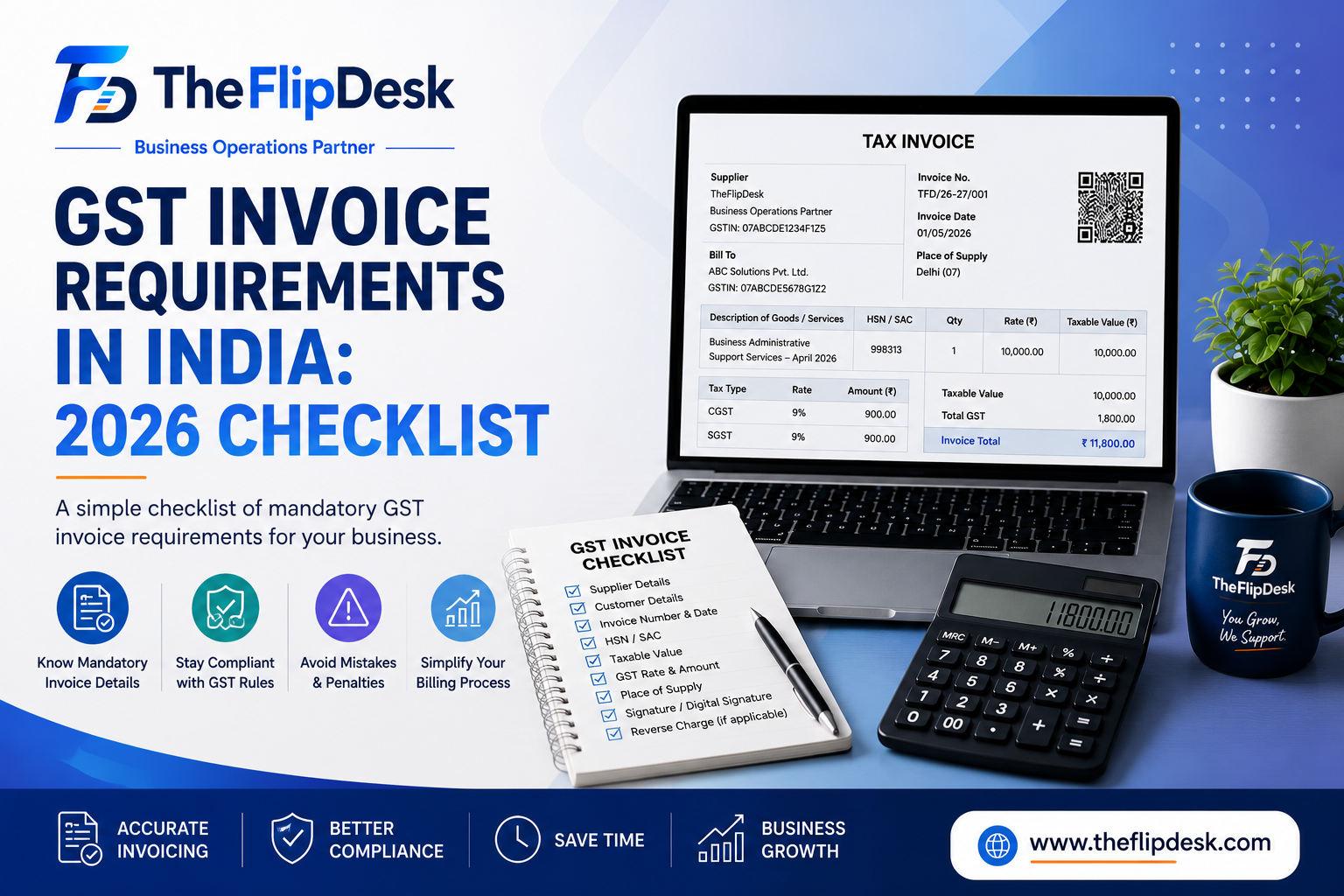
GST Invoice Requirements in India: 2026 Checklist
Issuing a GST invoice is more than simply adding GST to the price and sending a bill to your customer.
For a registered business making taxable supplies, the invoice needs to contain the required information prescribed under GST rules. Missing or incorrect details can create problems with record-keeping, reporting and compliance.
If you're a small business owner, freelancer, service provider or growing company, this checklist can help you review your GST invoices.
Important: GST requirements can vary depending on the nature of the transaction, type of taxpayer and applicable rules or exemptions. This article is for general information and should not be treated as tax or legal advice.
What Is a GST Tax Invoice?
A GST tax invoice is a document issued by a registered person for a taxable supply of goods or services.
Under the CGST framework, Rule 46 specifies the particulars that a tax invoice should contain.
There isn't one mandatory visual invoice design. What matters is that the applicable required particulars are properly included. CBIC's FAQ also confirms that GST does not prescribe one particular invoice format; the prescribed particulars are what matter.
GST Invoice Checklist
Before sending an invoice, check the following.
1. Supplier Details
Your invoice should include:
- Legal name of the supplier
- Business address
- GSTIN
These are among the basic particulars prescribed under Rule 46.
2. Unique Invoice Number
Every tax invoice should have a consecutive serial number.
The number should be unique for the financial year and follow the requirements regarding the permitted characters and numbering series.
For example:
TFD/26-27/001
The exact numbering system can differ between businesses, but it should be systematic and properly maintained.
3. Invoice Date
Clearly mention the date on which the invoice is issued.
Don't rely only on your accounting software's internal record. The actual invoice should display the applicable issue date.
4. Customer Details
For a registered customer, include the applicable:
- Name
- Address
- GSTIN
For an unregistered recipient, additional recipient and delivery details may be required depending on the circumstances and value of the supply.
5. HSN or Accounting Code
The applicable HSN code for goods or Accounting Code/SAC for services should be included as required.
The exact coding and reporting requirement can depend on the nature of supply and applicable rules/notifications, so businesses should use the appropriate code rather than guessing.
6. Description of Goods or Services
Don't use vague descriptions where a more meaningful description is appropriate.
For example:
Weak:
Service Charges
Better:
Business Administrative Support Services – March 2026
A clear description makes the invoice easier to understand and reconcile later.
7. Taxable Value
The invoice should show the taxable value of the supply after considering applicable discounts or abatements.
This is the amount on which the applicable GST is calculated.
8. GST Rate
The applicable tax rate should be shown.
Depending on the transaction, this may involve:
- CGST
- SGST/UTGST
- IGST
- Applicable cess, where relevant
The tax treatment depends on the nature and location of the supply.
9. Amount of GST
The applicable GST amount should be clearly shown.
For example:
| Particular | Amount |
|---|---|
| Taxable Value | ₹10,000 |
| CGST | ₹900 |
| SGST | ₹900 |
| Invoice Total | ₹11,800 |
This is only an illustration; the applicable rate depends on the supply.
CBIC's FAQ confirms that tax charged is required to be shown on the tax invoice.
10. Place of Supply
For an inter-State supply, the invoice needs to include the place of supply along with the State name as prescribed.
This is particularly important when determining whether the transaction involves IGST or CGST/SGST.
11. Reverse Charge Indication
Where applicable, the invoice should indicate whether the tax is payable under reverse charge.
This is another prescribed invoice particular under the GST rules.
12. Signature or Digital Signature
The applicable invoice requirements also provide for the signature or digital signature of the supplier or authorised representative.
For digitally generated invoices, businesses should ensure their invoicing process complies with the applicable requirements.
What About E-Invoicing?
E-invoicing is different from simply creating an invoice using accounting or billing software.
Under the GST e-invoicing system, applicable invoices are reported to an Invoice Registration Portal (IRP), which generates an Invoice Reference Number (IRN) and QR code.
The e-invoicing mandate was extended to taxpayers with aggregate annual turnover of ₹5 crore or more, with effect from 1 August 2023, subject to applicable conditions and exemptions.
Businesses should therefore check their specific applicability rather than assuming that every GST-registered business needs e-invoicing.
Common GST Invoice Mistakes
Even when a business uses accounting software, mistakes can happen.
Some common issues include:
- Incorrect GSTIN
- Duplicate invoice numbers
- Incorrect GST rate
- Missing HSN/SAC
- Incorrect place of supply
- Incorrect taxable value
- Wrong customer details
- Missing reverse-charge indication where applicable
- Incorrect invoice dates
- Poor record organisation
The problem isn't always the invoice itself. Sometimes the bigger issue is the process used to create, review and record invoices.
A Simple Pre-Send GST Invoice Check
Before sending an invoice, ask:
Supplier: Is our legal name, address and GSTIN correct?
Invoice: Is the invoice number unique and properly recorded?
Customer: Are the customer's details and GSTIN correct where applicable?
Service/Goods: Is the description and applicable HSN/SAC correct?
Tax: Is the taxable value, GST rate and tax amount correct?
Transaction: Is the place of supply and tax type correct?
Special conditions: Does reverse charge or e-invoicing apply?
Records: Has the invoice been properly recorded for accounting and GST reporting?
This simple review can catch many avoidable errors.
How TheFlipDesk Can Help
Managing invoices isn't just about creating a PDF.
Businesses also need to keep billing records organised, maintain supporting information and ensure that routine finance administration doesn't become a daily burden.
TheFlipDesk's Finance & Billing support can help businesses with areas such as:
- Invoice preparation and management
- Billing administration
- Bookkeeping support
- Expense record management
- Payment follow-ups
- Financial data organisation
- Routine finance administration
Our role is to help keep the operational side of billing organised so business owners can focus on running the business.
Need help with Finance & Billing?
[Talk to TheFlipDesk →]
Final Checklist
Before sending your next GST invoice, check:
☐ Supplier details
☐ GSTIN
☐ Unique invoice number
☐ Invoice date
☐ Customer details
☐ HSN/SAC
☐ Description
☐ Taxable value
☐ GST rate
☐ GST amount
☐ Place of supply, where applicable
☐ Reverse charge, where applicable
☐ Signature/digital signature, where applicable
☐ E-invoicing applicability, where applicable
A properly organised invoicing process makes compliance easier and reduces avoidable errors.
The goal isn't simply to create invoices. It's to create a reliable billing process.